Select Home Health & Hospice · Custom Web Experience
A healthcare website designed to make the next step feel clear.
Select Hospice needed a calm public-facing experience that helps Southern Utah families and professional referral partners understand the organization, its hospice services, and how to begin a conversation.
Visit Live Site (opens in a new tab)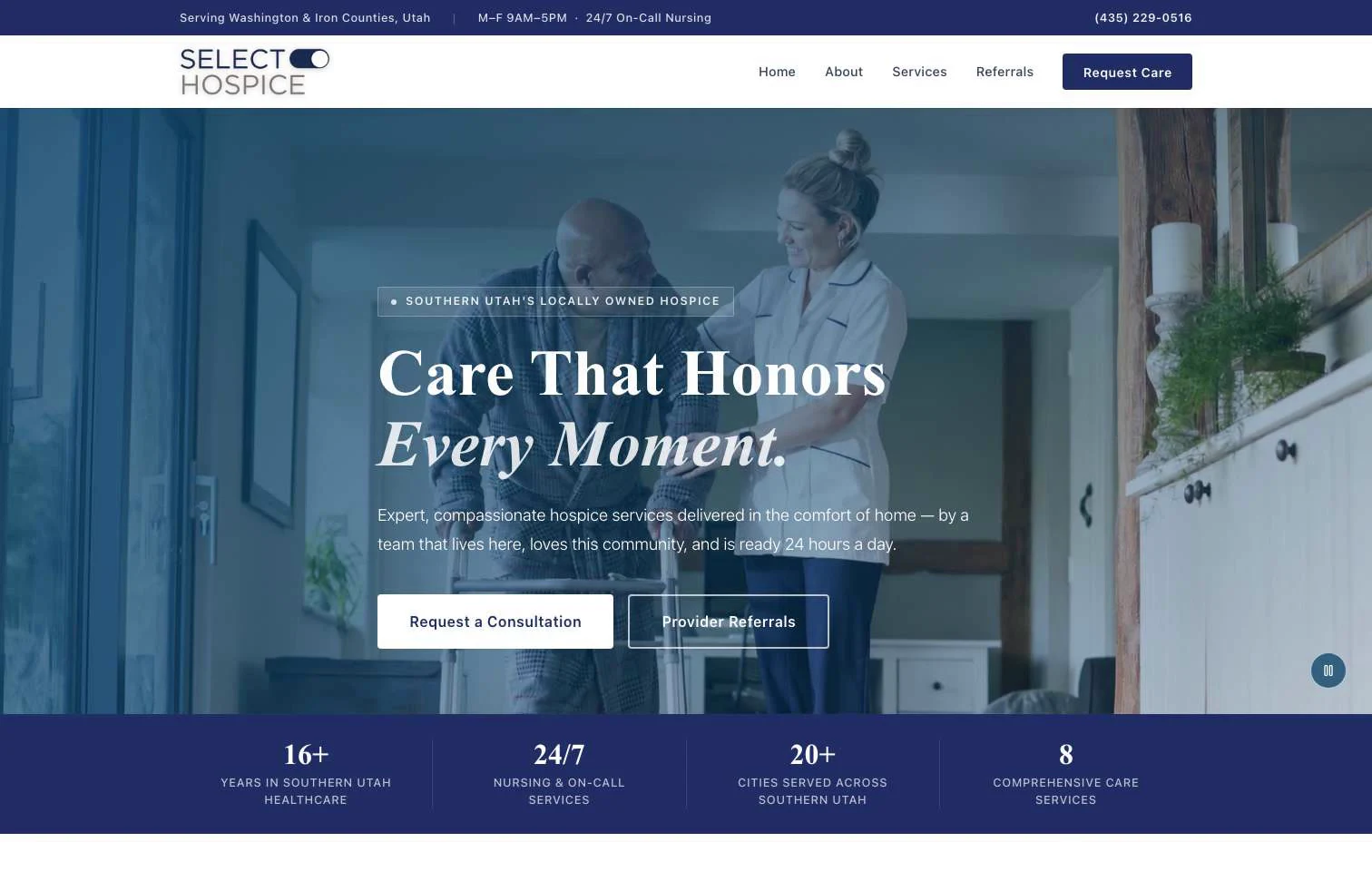
01
Project overview
A clear digital front door for different kinds of visitors.
People can arrive at a hospice website with very different levels of familiarity and very different reasons for visiting. Some are learning what care is available, some need to contact the organization, and healthcare professionals may be looking for the referral path.
The website organizes those needs without turning a sensitive decision into a complicated digital process.
The challenge
Make complex services easier to understand.
The design needed to present multiple hospice services, local context, availability information, and distinct calls to action while keeping the page calm and easy to scan.
The solution
Hierarchy before decoration.
Luke designed and built a custom responsive site around plain navigation, readable service groupings, Southern Utah context, and separate paths for requesting a consultation or making a provider referral. The visual system supports understanding without competing with the content.
Website experience
A clear path from understanding to action.
The website moves from a concise introduction into local context, service information, and focused Request Care and contact paths.
Information hierarchy
Care options are grouped for quick understanding.
The site introduces the scope of hospice care at a glance, then lets visitors move into more detail only when they need it. The portfolio presentation reflects the site's real service structure without recreating every service page.
- 01Pain & Symptom Management
- 02Skilled Nursing Care
- 03Home Health Aide Services
- 04Emotional & Spiritual Support
- 05Bereavement Care
- 06Chaplain Services
- 0724-Hour Nursing Services

Trust & local context
Trust starts before the first conversation.
The site grounds the organization in Southern Utah and pairs its service information with a human, local-care story. Availability language is kept specific: office hours are listed separately from the 24/7 on-call nursing support described for enrolled patients.
- Locally owned and operated
- Serving Washington and Iron Counties
- Separate office-hours and on-call information
Visitor paths
Different reasons for visiting. Clear next steps for each.
The information architecture separates four common intentions so service education, family context, professional referrals, and general contact do not compete for attention.
Learning about care
Service summaries and dedicated pages explain the available hospice support.
Family or caregiver
Local context, service details, and consultation actions establish a clear starting point.
Healthcare provider
A dedicated referrals route separates professional intake information from general contact.
Ready to contact
Phone and Request Care actions lead directly to the organization's contact options.
Request care & contact
The site continues from information into a real next step.
Once someone is ready to act, the site separates two routes: families can request a consultation by phone or focused form, while healthcare professionals receive a dedicated referral path. Both move directly into a conversation without requiring an account or portal.
- 01Understand available care
- 02Choose consultation or referral
- 03Call or send a focused message
Responsive experience
The hierarchy holds together on smaller screens.
Navigation, service groupings, readable text, and contact actions adapt to mobile layouts so the essential information remains understandable without compressing the experience into a desktop page viewed at phone size.
Readable type · adaptable hierarchy · touch-ready contact paths
Engineering & delivery
A purpose-built informational site with a restrained technical footprint.
The implementation uses a component-based responsive frontend, prerendered public routes, optimized image assets, and a small server endpoint for contact delivery. It remains a public website—not a patient portal or clinical record system.
Frontend
Reusable page and layout components support a consistent experience across the site.
Delivery
Static public content is delivered efficiently, with a focused Worker endpoint supporting the contact form.
Outcome
A clearer public presence for the organization.
Select Hospice now has a production website that presents its services and Southern Utah identity clearly, supports distinct family and professional-referral journeys, and makes contact straightforward across device sizes.